Which Labels Are Best for Jars? Everything You Need to Know Before You Print
You poured your heart into what’s inside that jar. The honey, the candle wax, the lotion, the jam, all of it took real time, care, and money to make. So why does the label on the outside so often get picked last, in a rush, right before launch day?
If you are searching for the best labels for jars, chances are you have already felt the sting of a label that peeled in the fridge, smudged on a hot afternoon, or just looked cheap sitting next to a competitor’s jar on the same shelf. A flimsy label does not only look bad. It quietly tells customers that what’s inside might be flimsy too.
Let’s fix that, for good. By the end of this guide, you will know exactly what to look for, what to avoid, and how to pick a label that holds up as well as the product you worked so hard to create.
Why the Right Jar Label Matters More Than You Think
People judge a jar in about three seconds. Before anyone reads an ingredient list or smells a candle, their eyes land on the label first. If it looks crisp, clean, and well-made, the product feels trustworthy. If it looks crooked, dull, or worn, the product feels cheap, even when what’s inside is genuinely wonderful.
This is the quiet cost of choosing the wrong label. You are not just buying a sticker. You are buying the first impression that decides whether someone picks up your jar or walks right past it.
And it does not stop at the shelf. A label that fades after one wash, peels in the freezer, or smudges in a customer’s bag shows up in reviews, refund requests, and quiet brand switching. Most unhappy customers will not tell you why they stopped buying. They will just stop.
The 3 Things Every Great Jar Label Needs
Before you even think about colors or fonts, three things decide whether a jar label succeeds or fails: the material, the adhesive, and the finish. Get these three right, and your label will look good and survive everything your customer puts it through. Get even one of them wrong, and the prettiest design in the world will still let you down.
1. Label Material for Glass Jars
The right label material for glass jars depends entirely on how that jar will be used and where it will spend its life.
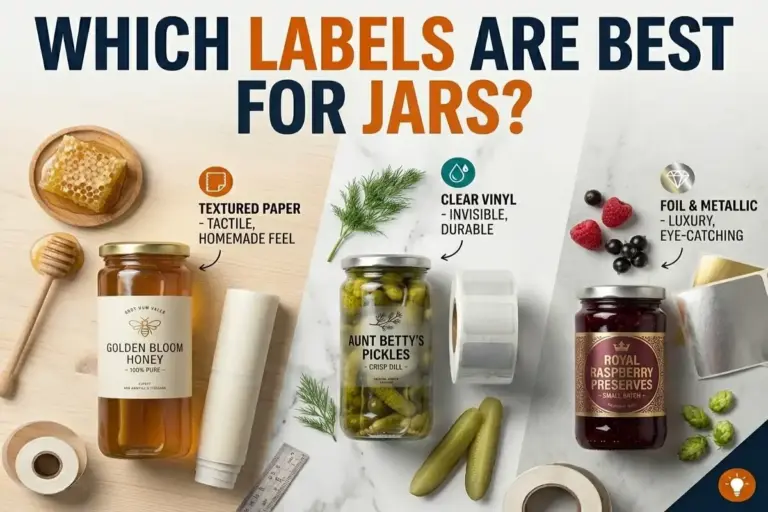
- Paper labels: These are affordable and give a charming, classic, rustic feel. But they soak up moisture fast and fall apart in a fridge, a freezer, or a steamy bathroom.
- Vinyl labels: These are tough, flexible, and naturally resist water. A strong, reliable choice for jars that get handled often or live in a kitchen.
- BOPP (polypropylene) labels: These are thin, strong, and resistant to oil, water, and scratches. Many of the best labels for jars on store shelves today use BOPP, especially for food, drinks, and skincare products that face constant handling.
If your jar will ever meet wet hands, cold air, or kitchen grease, paper is a gamble you don’t need to take.
2. Adhesive for Glass Jar Labels
This is the part most people forget, and the part that ruins the most labels. The right adhesive for glass jar labels has to match the exact conditions the jar will live through, not just look good on the day it’s printed.
- Permanent adhesive: This stays locked on through fridges, freezers, and shipping bumps. Best for jam, honey, sauces, and skincare that needs to stay put for good.
- Removable adhesive: This peels away cleanly without leaving sticky residue, perfect for jars customers reuse or refill, like candle jars or DIY kits.
- Freezer-grade adhesive: This is built to grip even through cold, damp glass. A non-negotiable if your jar ever sees the inside of a freezer.
A beautiful label with the wrong adhesive will curl, lift, or fall off within days. That is not a design failure. That is an adhesive problem, and it is one of the most common reasons jar labels fail in the real world.
3. Finish and Lamination
The finish is the protective layer over everything underneath, and it also sets the mood and feel of your brand.
- Matte laminate: This feels soft, modern, and resists fingerprints. A favorite for skincare and candle brands.
- Gloss laminate: This is shiny, bold, and catches the eye fast. Great for jams, sauces, and bright, playful packaging.
- Soft touch finish: This has a premium, velvety feel that makes a simple jar feel like a luxury item on the shelf.
Lamination is also exactly what gives you true waterproof jar labels, the kind that survive condensation, spills, and humid bathrooms without bubbling, peeling, or fading into a blur.
4 Best Labels for Jars, by Use Case
There is no single “best” label for every jar. The best labels for jars depend entirely on what’s inside them and where they will live. Here is a simple, honest breakdown by use case.
1) Candle Jar Labels
Candle jars get hot, get handled often, and are frequently reused once the wax is gone. Vinyl or BOPP with a matte or soft touch finish stands up beautifully to heat and constant handling, while a removable adhesive lets customers clean out and reuse the jar without leaving behind sticky, ugly residue.
2) Spice and Food Jar Labels
These labels live near steam, grease, and the occasional kitchen accident. Custom jar labels printed on BOPP, with a permanent, food-safe adhesive and a matte or gloss finish, stand up to heat, oil splashes, and the daily wear of being picked up and put back near the stove.
3) Skincare and Cosmetic Jar Labels
Bathrooms are humid, and skincare jars get splashed and handled with wet hands daily. Waterproof jar labels with a strong permanent adhesive and a soft touch or matte finish keep branding looking sharp through every shower, sink splash, and steamy morning routine.
4) Fridge, Freezer, and Reusable Mason Jars
This is exactly where dishwasher-safe jar labels earn their keep. Homemade jam, frozen broth, or refillable mason jars need a label material for glass jars that can take on cold, constant moisture, and even a trip through the dishwasher without curling at the edges or fading into nothing.
Common Jar Labeling Mistakes That Quietly Cost You Sales
Even genuinely great products lose sales over small labeling mistakes. Watch out for these:
- Choosing paper labels for anything that touches moisture, cold, or steam.
- Using a removable adhesive on a jar that needs to survive shipping or long shelf time.
- Skipping lamination on a jar headed for a steamy kitchen or humid bathroom.
- Picking a glossy finish that shows every fingerprint on a brand that’s meant to feel clean and matte.
- Printing at home on a printer and paper that were never built for waterproof, long-lasting ink.
Each one of these feels small in the moment. But a peeling label, a faded barcode, or a smudged logo can quietly cost you a repeat customer, a five-star review, or even a retail account that was about to say yes.
How to Choose the Right Label for Your Jars
Here is a simple way to land on the right choice without the guesswork.
- Ask where the jar will live. Fridge, freezer, bathroom, pantry, or open shelf, this decides your material and adhesive.
- Ask how the jar will be handled. Reused, refilled, shipped, or gifted, this decides your adhesive type.
- Ask what feeling you want your brand to give. Rustic and warm, clean and modern, or bold and bright, this decides your finish.
- Match material, adhesive, and finish together, instead of choosing each one on its own.
- Order a small test batch before committing to a full print run.
That last step alone saves more time, money, and heartbreak than almost anything else on this list. A label that looks perfect on a screen can behave very differently on real glass, in a real fridge, in real hands.
The Real Cost of Getting It Wrong
A cheap label might save you a few cents per jar today. But a label that peels, fades, or smudges costs you something far more expensive: trust. Most customers won’t bother to complain about a bad label. They will simply, quietly, choose a different brand next time, the one whose jar looked put together from the very first glance.
Your product deserves a label that works just as hard as you did to make what’s inside it.
Final Thoughts
So, which labels are best for jars? The honest answer is that it depends on your jar’s job. Candle jars need heat-resistant, reuse-friendly labels. Food jars need food-safe, grease-resistant labels. Skincare jars need waterproof, humidity-proof labels. And anything headed for a fridge or freezer needs a label tough enough to handle the cold without ever giving up.
What never changes is this: the right combination of material, adhesive, and finish is what turns an ordinary jar into a product people trust, remember, and reach for again.
Let’s Get Your Jars Labeled Right, the First Time
You don’t have to figure this out alone, and you definitely don’t need to learn it the hard way through a failed print run. At Accuxel Prints and Design, we help small-batch makers and growing brands choose and print custom jar labels built for exactly what their jars go through, whether that’s a freezer, a bathroom shelf, or a busy kitchen counter.
Reach out to us at Accuxel Prints and Design today, and let’s create jar labels that look as good as your product deserves, and stay that way through every fridge, freezer, and shelf they touch.