You finally got your product ready. The bottles arrived. You ordered your stickers, excited to slap them on and snap that perfect product photo. Then you peel one off and your stomach drops. It hangs off the edge. Or it swims in a sea of empty bottle space. It just looks wrong.
This is one of the most common (and most avoidable) mistakes small business owners make. And it almost always comes down to one thing: not knowing the standard sticker sizes for bottles before placing an order.
Here is the good news. You do not need a design degree to get this right. You just need a few simple numbers, and a little guidance from someone who has seen this go wrong (and right) many times before. That is exactly what this guide is for.
Why Bottle Sticker Sizing Matters More Than You Think
A sticker that is even slightly off can quietly hurt your business in ways you might not expect.
- It makes your brand look unfinished, even if your product is excellent.
- It can hide important details like ingredients or barcodes.
- It wastes money on reprints, which adds up fast for a small budget.
- It can shake your confidence right when you need it most, during a launch.
Getting your label size right the first time is not just a printing detail. It is part of how your customer forms their first impression of you. And first impressions are hard to undo.
What Determines the Right Bottle Label Size
Before we get to the size chart, let’s talk about what actually shapes your decision. Three things matter most:
1. Bottle Shape and Circumference
A round bottle needs a label that wraps cleanly without folding awkwardly. You measure the bottle circumference, the distance around the middle of the bottle, to figure out the right label width.
2. Bottle Type and Use Case
A skincare dropper bottle has a very different space than a wine bottle or a sauce jar. Your label diameter or label height will change depending on what you are packaging.
3. Label Shape
Round labels, oval labels, and rectangle labels all behave differently on curved glass or plastic. The shape you pick affects how much breathing room your design needs.
Standard Bottle Label Size Chart
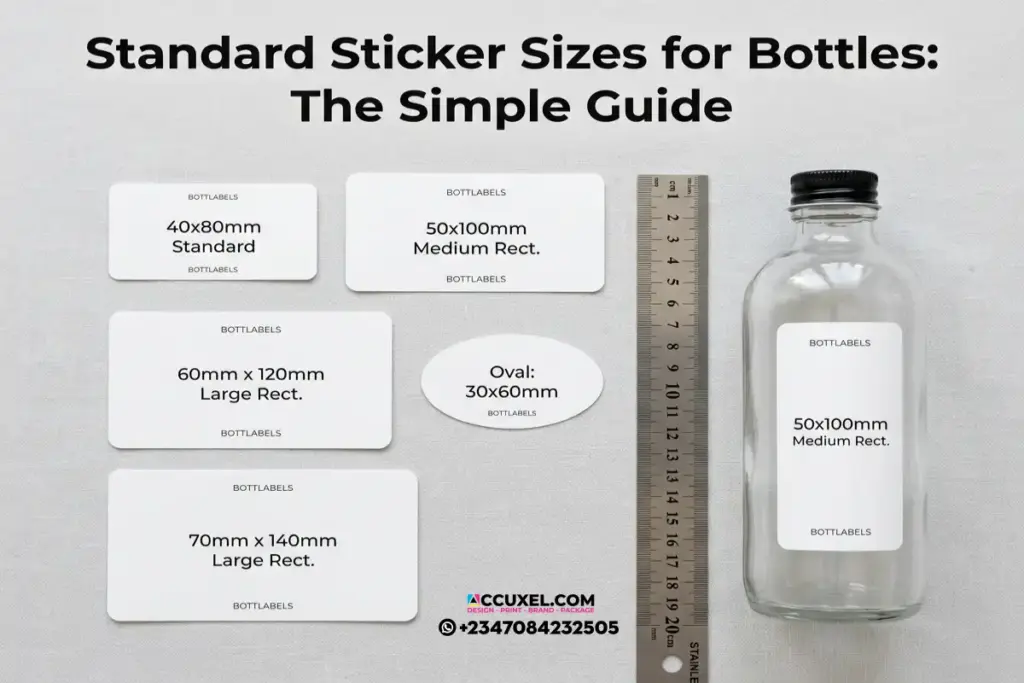
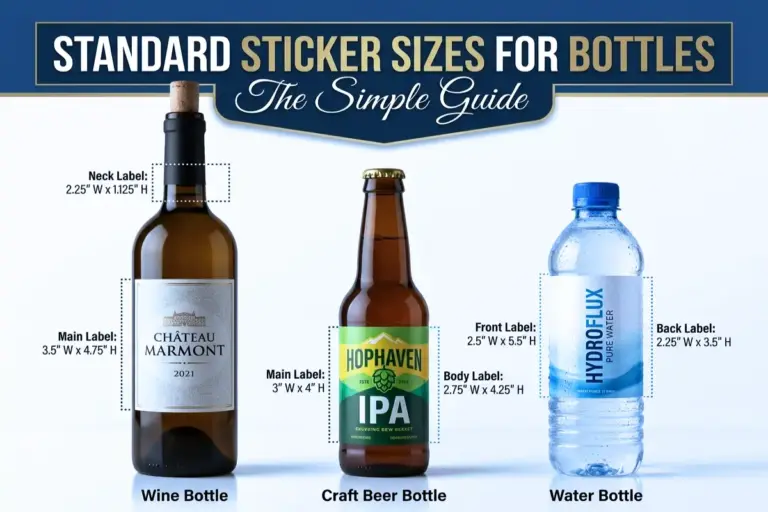
Here is a simple bottle label size chart to use as your starting point. These are the most common sizes used across the packaging industry, shown in both inches and centimeters, so you can measure with whatever tool you have on hand.
| Bottle Type | Common Bottle Size | Label Shape | Standard Label Size (Width x Height) |
|---|---|---|---|
| Water bottle (16.9 oz / 500 ml) | 16.9 oz / 500 ml | Rectangle (wraparound) | 8 in x 2 in (20.3 cm x 5 cm) |
| Wine bottle | 750 ml | Rectangle or square | 3.5 in x 4 in (8.9 cm x 10.2 cm) |
| Spirits bottle | 750 ml | Rectangle | 3 in x 4.5 in (7.6 cm x 11.4 cm) |
| Skincare dropper bottle | 1 oz / 30 ml | Round or rectangle | 1.5 in x 2 in (3.8 cm x 5 cm) |
| Sauce or condiment jar | 8 oz / 227 g | Round or oval | 2 in x 3 in (5 cm x 7.6 cm) |
| Beverage can or bottle | 12 oz / 355 ml | Wraparound rectangle | 7.5 in x 3.5 in (19 cm x 8.9 cm) |
| Cosmetic jar (cream/balm) | 2 oz / 57 g | Round | 2 in diameter (5 cm diameter) |
| Candle jar | 8 oz / 227 g | Round or rectangle | 3 in x 4 in (7.6 cm x 10.2 cm) |
A gentle reminder before you order: this chart is a starting point, not a strict rulebook. Your bottle might be a slightly different shape than the standard. That is completely normal, and it is exactly why we always recommend the next step.
How to Measure Your Own Bottle (Even If You Have Never Done This Before)
If you are nervous about getting this part wrong, take a breath. Here is a simple way to do it yourself in under five minutes.
- Wrap a measuring tape or string around the middle of the bottle. This gives you the circumference. Mark where it overlaps and measure that length.
- Subtract a small gap. Leave about a quarter inch (0.5 cm) of space, so your label does not wrap completely around and overlap itself.
- Measure the height of the area where you want the label to sit, from the top edge to the bottom edge.
- Round down slightly if you are between sizes. A label with a little breathing room always looks better than one that is stretched too tight.
- Write both numbers down in inches and centimeters, so you have them ready when you place your order.
If this still feels uncertain, you are not alone. Many first-time business owners send us a photo of their bottle instead, and we help them figure out the size from there.
Choosing the Right Label Material for Bottles
Size is only half the story. The material matters just as much, especially if your bottle will face moisture, oil, or handling.
Waterproof Labels for Bottles
If your product touches water, condensation, or the inside of a fridge, waterproof labels for bottles are not optional. Look for BOPP material or vinyl labels with a water-resistant adhesive. These hold up through humidity, splashes, and even ice baths without peeling or smudging.
Custom Bottle Stickers for Branding
If you want your packaging to feel like a true reflection of your brand, custom bottle stickers give you full control over shape, finish, and size. You are not stuck choosing from a generic template. You can match your label exactly to your bottle and your brand personality.
Special Considerations by Bottle Category
Round Bottle Label Sizes
For round bottle label sizes, always account for the curve. A flat design that looks perfect on screen can look stretched or warped once it wraps around glass. This is why we recommend a small bleed area and a test proof before a full print run.
Wine Bottle Label Dimensions
Wine bottle label dimensions tend to be more flexible than people expect. Many wineries use a front label around 3.5 by 4 inches (8.9 by 10.2 cm) paired with a smaller neck label. This combination gives you space to tell your story without overcrowding the bottle.
Common Mistakes to Avoid
- Ordering a label sized only from a screen measurement without checking the actual bottle in hand.
- Forgetting to leave bleed space at the edges, which can cause text or logos to get cut off.
- Choosing a glossy finish for a bottle that will sit in a fridge or shower, where moisture causes peeling.
- Skipping a sample print before committing to a large batch.
Every one of these mistakes is fixable before printing, but costly after. A few extra minutes of planning saves you from a box of stickers that simply do not work.
Final Thoughts: You Don’t Have to Get This Perfect Alone
Choosing the right standard sticker sizes for bottles does not need to feel overwhelming. Once you know your bottle’s circumference, height, and shape, the rest becomes a simple matching exercise. And if numbers and measurements are not your strong suit, that is completely okay. This is exactly the kind of detail a good packaging partner should help you carry.
Your product deserves labels that fit it perfectly, look professional, and hold up to whatever your customers throw at them, literally.
Ready to get your bottle labels sized and printed right the first time? Reach out to us at Accuxel Prints and Design. Send us a photo or the measurements of your bottle, and our team will help you find the exact size, material, and finish that fits your product and your budget, with a proof you can approve before we print a single sticker.