Have you ever received a batch of stickers or labels and wondered whether they were actually vinyl or just paper?
Well, you’re not alone.
Many business owners discover the difference only after their labels start peeling off bottles, wrinkling from moisture, fading in sunlight, or tearing during handling. By then, the damage is already done. Products look less professional, customers lose confidence, and replacement costs begin to add up.
Knowing how to tell if a sticker is vinyl or paper can save you money, protect your brand image, and help you choose the right material for future orders.
In this guide, you’ll learn simple ways to identify sticker materials, understand the differences between vinyl vs paper stickers, and determine which option is best for your packaging, labeling, and branding needs.
Why Sticker Material Matters More Than Most People Realize
A sticker does much more than display a logo or product information.
It represents your brand.
When a customer picks up your product, one of the first things they notice is the label. A high-quality sticker communicates professionalism and trust. A damaged, peeling, or faded sticker can create the opposite impression.
The right material affects:
- Product appearance
- Durability
- Moisture resistance
- Shelf life
- Customer perception
- Brand credibility
This is why understanding the difference between a paper sticker and a vinyl sticker is so important.
What Is a Vinyl Sticker?
A vinyl sticker is made from a flexible plastic material known as self-adhesive vinyl (SAV).
Unlike paper labels, vinyl stickers are designed to withstand challenging environments, including moisture, handling, sunlight, and temperature changes.
Common applications of Vinyl Stickers:
- Product labels
- Bottle labels
- Cosmetic labels
- Food packaging labels
- Outdoor stickers
- Vehicle decals
- Window graphics
- Branding stickers
Many businesses prefer waterproof vinyl stickers because they maintain their appearance even after prolonged exposure to water and humidity.
What Is a Paper Sticker?
Paper stickers are made from coated or uncoated paper stock with adhesive backing.
They are typically more affordable than vinyl and work well for short-term indoor applications.
Common uses of Paper Labels:
- Retail labels
- Address labels
- Packaging seals
- Event stickers
- Promotional labels
- Indoor product labels
While paper stickers can produce excellent print quality, they generally offer lower durability than vinyl.
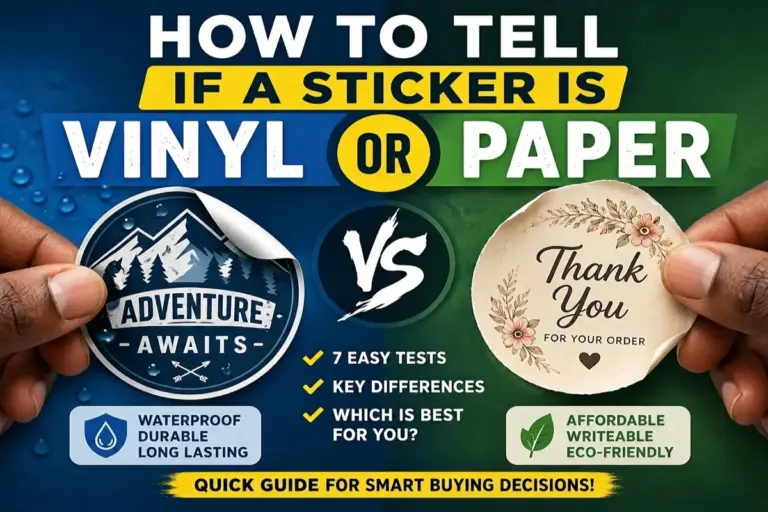
How To Tell If A Sticker Is Vinyl or Paper: 7 Easy Tests
Fortunately, identifying sticker material is usually straightforward.
Here are seven practical methods you can use.
1) Feel the Surface Texture
The quickest test is simply touching the sticker.
Vinyl stickers usually feel:
- Smooth
- Slightly soft
- Flexible
- Plastic-like
Paper stickers often feel:
- Dry
- Fibrous
- Rougher
- Similar to cardstock or paper
If it feels like plastic, there’s a strong chance it’s vinyl.
2) Try the Tear Test
One of the easiest ways to identify vinyl stickers is by checking how they tear.
Paper stickers tear easily and produce rough, uneven edges.
Vinyl stickers are much more resistant to tearing and often stretch slightly before ripping.
If the material resists tearing, it is likely vinyl.
3) Check Water Resistance
This is one of the most reliable methods.
Place a few drops of water on the sticker surface.
With paper stickers:
- Water may soak in
- The surface can wrinkle
- Colors may run
- Edges may begin to lift
With waterproof vinyl stickers:
- Water beads on the surface
- The print remains unaffected
- The material stays intact
This test quickly reveals whether the sticker is suitable for wet environments.
4) Bend the Sticker
Flexibility provides another clue.
Vinyl stickers bend smoothly without creating permanent creases.
Paper stickers tend to develop visible fold marks when bent.
If the sticker springs back into shape, it’s probably vinyl.
5) Examine the Edges Closely
Look carefully at the cut edge.
Paper stickers usually reveal paper fibers along the edge.
Vinyl stickers show a cleaner, more uniform edge with no visible fibers.
A magnifying glass can make this difference even easier to spot.
6) Check for Stretch
Vinyl materials have some elasticity.
When gently pulled, vinyl may stretch slightly before returning to shape.
Paper materials have virtually no stretch and will tear almost immediately.
This characteristic is one reason vinyl performs better on curved packaging surfaces.
7) Look at the Backing and Adhesive Layer
Many premium vinyl labels use stronger adhesive systems designed for long-term performance.
While this method isn’t foolproof, higher-end custom vinyl sticker printing products often feature thicker liners and more durable adhesives than standard paper labels.
Vinyl vs Paper Stickers: Side-by-Side Comparison
| Feature | VINYL STICKERS | PAPER STICKERS |
| Material | Plastic-based | Paper-based |
| Waterproof | Yes | No |
| Tear Resistance | High | Low |
| Durability | Excellent | Moderate |
| Outdoor Use | Ideal | Not Recommended |
| UV Resistance | High | Limited |
| Moisture Resistance | Excellent | Poor |
| Lifespan | Long-Term | Short-Term |
| Premium Appearance | High | Moderate |
| Cost | Higher | Lower |
For businesses selling products in competitive markets, vinyl often delivers greater long-term value despite the higher initial cost.
When Should You Choose Vinyl Stickers?
Vinyl is usually the better option when durability matters.
Choose vinyl for:
- Water bottle labels
- Beverage packaging
- Cosmetic products
- Refrigerated foods
- Outdoor branding
- Window graphics
- Industrial labels
- Long-term product packaging
Businesses that invest in custom vinyl sticker printing often experience fewer label failures and stronger brand presentation.
Imagine a customer reaching for your product after weeks in a refrigerator. The label still looks clean, vibrant, and professional.
That consistency builds trust.
When Are Paper Stickers the Better Choice?
Paper stickers remain an excellent option in many situations.
Choose paper when:
- Budget is the primary concern
- Labels will remain indoors
- The product has a short shelf life
- Customers need to write on the label
- Moisture exposure is unlikely
Many businesses successfully use paper labels for dry goods, promotional campaigns, and temporary applications.
The key is choosing the right material for the environment.
The Hidden Cost of Choosing the Wrong Sticker Material
Many businesses focus only on the sticker price.
But the real cost comes later.
A cheaper label that fails can result in:
- Product returns
- Reprinting expenses
- Repackaging costs
- Damaged customer perception
- Lost sales opportunities
Imagine spending thousands on packaging only for labels to wrinkle, fade, or peel.
The savings disappear quickly.
This is why experienced packaging professionals evaluate total performance and not just material cost.
Frequently Asked Questions
Q) Are vinyl stickers always waterproof?
A) Most vinyl stickers are waterproof, but performance depends on the printing method, ink, and finishing. Laminated vinyl generally provides the best protection.
Q) Can paper stickers be waterproof?
A) Some specialty paper materials offer water resistance, but they rarely match the durability of waterproof vinyl stickers.
Q) Which lasts longer: vinyl or paper?
A) Vinyl typically lasts significantly longer due to its resistance to moisture, tearing, and UV exposure.
Q) How can I identify vinyl stickers quickly?
A) The fastest methods are checking the texture, performing a water test, and evaluating tear resistance.
Q) Are vinyl stickers worth the extra cost?
A) For products exposed to moisture, handling, refrigeration, or outdoor conditions, vinyl usually provides a much better return on investment.
Final Thoughts
Knowing how to tell if a sticker is vinyl or paper can prevent costly mistakes and help you make smarter packaging decisions.
If you need a quick rule of thumb, remember this:
Paper stickers are economical and suitable for short-term indoor use, while vinyl stickers are durable, waterproof, tear-resistant, and built for long-term performance.
When your brand reputation depends on how your products look on the shelf, sticker quality matters more than many businesses realize.
Whether you need product labels, bottle labels, cosmetic labels, packaging stickers, or premium waterproof branding solutions, choosing the right material can make all the difference.
Ready to upgrade your packaging with Professional Sticker Printing?
Contact us at Accuxel Prints and Design today for expert guidance on sticker materials, custom label printing, and packaging solutions designed to help your products stand out, last longer, and leave a lasting impression on your customers.