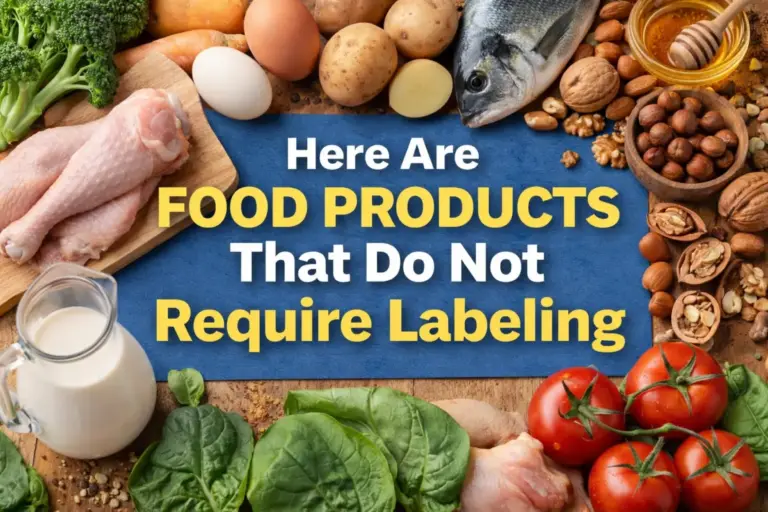
When you walk into a store and pick up a food item, you most likely check the label. You want to know what it contains, how many calories it has, if it is safe for you to eat, or if it has something you are allergic to. Food labels are important because they help people make safe and healthy choices. But the truth is, not every food product has a label. Some foods are sold without labels, and this is not always against the law.
There are certain food products that do not need labeling under food safety rules in many countries. This can be confusing to some people, especially when they are trying to understand what they are eating. So, let’s talk about the kinds of food that do not require labels, and explain exactly why they are allowed to be sold this way and what it means for people who buy them.
Food Products That Do Not Require Labeling
1) Fresh Fruits and Vegetables
Fresh fruits and vegetables that are sold whole and unprocessed usually do not need any labels. When you go to the market and buy bananas, oranges, carrots, or tomatoes, you will see that they are often displayed openly without any packaging or labels. This is because these items are in their natural state and have not gone through any changes. They are not mixed with anything, and no ingredients are added.
Since these fruits and vegetables are easy to identify by looking at them, the law does not require sellers to put labels on them. Also, most people know how to eat them safely. Unless a fruit or vegetable is cut, peeled, or packaged, it usually does not require a label.
2) Raw Meat And Poultry From Small Stores
In many countries, large meat producers are required to add labels to their products. But in some cases, small butcher shops or local farmers may sell raw meat and poultry without labels. If the meat is sold fresh and not pre-packaged, it may not need a label.
When you go to a butcher and ask for one kilogram of beef or chicken, the seller may cut it in front of you and wrap it without a label. This is allowed in many areas because the food is not processed or packaged ahead of time. However, if the meat is seasoned or marinated, it might then require a label.
3) Foods Sold In Bulk
Foods that are sold in large containers or bins, like grains, nuts, seeds, and spices, often do not come with labels. These items are sold by weight, and customers scoop or pick the amount they want. Since these foods are not pre-packaged, labeling rules are different for them.
Many supermarkets have sections where you can find items like rice, beans, or almonds in bulk. While there may be a small sign showing the name and price, there is usually no full label with ingredients or nutrition details. The main reason is that these foods are not considered packaged, so they are not always required to have labels.
4) Foods Made And Sold At The Same Place
Some food items that are prepared and sold in the same place do not need to carry labels. For example, a bakery that bakes bread and sells it on-site might not need to label each loaf. If you go to a local bakery and buy fresh bread, muffins, or cakes, they might be handed to you in a plain paper bag without any printed information.
This is because the food is made and sold directly to the customer without being sent to another store or packaged for long-term sale. As long as the food is not sent elsewhere or sold in bulk packaging, it often does not require labeling under the law.
5) Small Businesses And Home-Based Producers
In many places, small businesses and home food producers are allowed to sell certain foods without labeling them. This is common for home-baked goods, jams, or snacks that are made in small batches. The rules may be different from one area to another, but the idea is to support small food sellers who are not mass-producing their items.
For example, if someone makes shortcakes at home and sells them at a local market, they might not be required to add a label. However, some places ask these sellers to include basic information like ingredients or allergy warnings, even if a full label is not needed.
6) Single-Ingredient Foods
Any food that contains only one ingredient often does not need a label. This includes items like sugar, salt, flour, and oil. If you buy pure honey or plain yogurt that has not been flavored or mixed with anything else, it may not be required to carry a label.
The idea is that these foods are simple and clear. Since they only contain one item and nothing else has been added, it is easy to understand what they are. People can make choices based on that one known ingredient.
7) Foods Sold For Immediate Consumption
Foods that are sold to be eaten right away often do not require labeling. This includes food sold in cafeterias, food trucks, street vendors, and restaurants. For example, if you buy a shawarma from a roadside stand, it likely won’t come with a label listing ingredients or calories.
These food items are considered ready-to-eat and are prepared on the spot. Since you are not taking them home or storing them, the law does not always require labeling. However, some businesses still give out information about ingredients, especially if asked.
8) Fresh Seafood From Local Markets
Fresh fish or seafood sold at local docks or open markets is usually not labeled. If you buy shrimp, crab, or catfish that is caught locally and sold fresh without packaging, it may not require a label. These items are often kept on ice and sold by weight directly to customers.
Again, this is because they are not processed or packaged. Once the seafood is packaged or seasoned, it may then need to follow food labeling laws.
9) Water and Ice
Plain water and ice, especially when sold in public places or restaurants, usually do not require labeling. A cup of ice or a glass of drinking water served in a cafe or handed to you at a public event is not labeled. This is because water is not considered a packaged food unless it is bottled.
If water is sold in sealed bottles, then it must follow the labeling rules. But water that is served directly or ice that is made on-site and used in drinks often does not carry any labels.
10) Unpackaged Baked Goods
When you buy baked goods like bread rolls, doughnuts, or pastries from open display counters, they are often sold without labels. If these items are made on-site and not pre-packaged, the seller is not always required to provide full labeling.
However, if the bakery uses common allergens like peanuts, milk, or eggs, they may be required to provide that information somewhere in the shop. This is to help people with food allergies stay safe even if there is no label on the item.
Not all foods require labeling, especially if they are sold fresh, unpackaged, or directly from the producer. Labeling rules are designed to protect health without making it hard for small owners and vendors to operate.
However, people still need to be careful when buying unlabeled foods. Always ask for information if you are not sure what is in a product. Cleanliness, freshness, and trust in the seller are important. Knowing the types of foods that do not need labeling helps you shop with more understanding.